
Course (PDF) · Social Studies
Population
by Abel Asiedu · 48 pages · English · PDF
A complete course on Population as per the GES standard
Free
Sign in or create an account to download it free.
About this resource
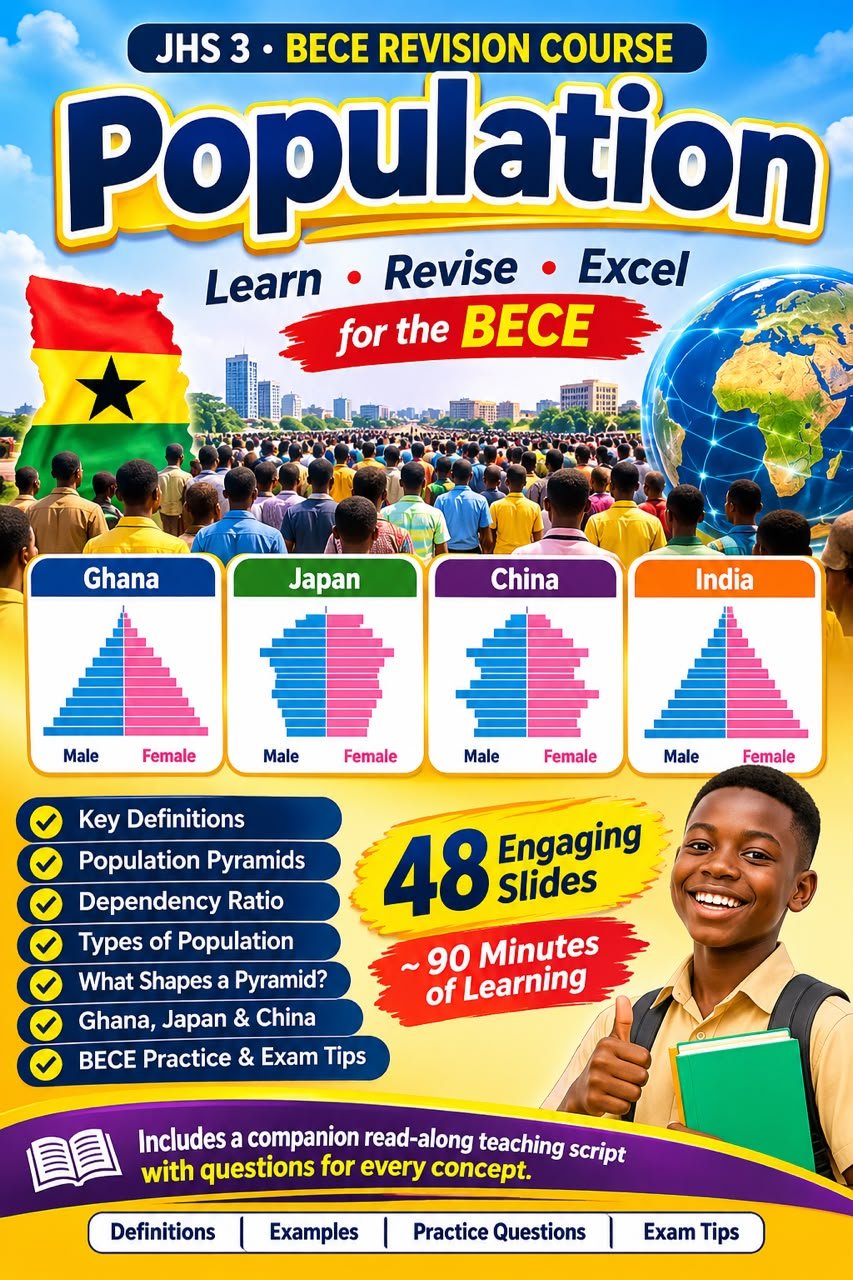
This is a complete, exam-focused course on *Population* for Junior High School Social Studies, built for students preparing for the *BECE*. It has 48 slides and takes about 90 minutes to teach. Every key definition is stated in exact textbook-style wording with the keywords highlighted, so students learn the phrases that earn marks. Each new idea begins with a warm-up question, because students have already met the topic and revision works best when they recall before they are told. The course uses clear population pyramids from Ghana, Japan, China and India. Students learn to read them, classify them and explain why they differ. They also practise the dependency ratio with worked calculations and finish with a BECE-style quiz and exam tips.
What you will be able to do
- By the end of this course, students will be able to:
- - State the exact meaning of *population, **census, **population structure, **population pyramid* and *dependency ratio*.
- - Read a population pyramid by age and sex.
- - Calculate the dependency ratio from age-group figures.
- - Identify expansive, constrictive and stationary pyramids from their shape.
- - Explain how fertility, mortality, migration, living standards and healthcare change a pyramid.
- - Compare the population structures of Ghana, Japan and China.
- - Describe the problems of youthful and ageing populations, and suggest solutions.
Contents
*1. Welcome* - Cover, roadmap and learning outcomes *2. Key definitions* - Warm-up: what is a population? - Population - Census - Population structure *3. Reading pyramids* - Warm-up: what do you notice? - Population pyramid - How to read a pyramid: five rules - Three age bands: dependents and workers - Dependency ratio, with a worked example *4. Types of population and pyramid* - Warm-up: predict the shape - Youthful, ageing and aged populations - Expansive pyramid, with examples from India and Ghana - Constrictive pyramid, including the vase-shaped type - Stationary pyramid - High-income countries, where births fall *5. What shapes a pyramid* - Think, pair, share - Six forces: fertility, mortality, migration, smaller families, living standards and healthcare - Developed and developing countries compared *6. Case studies* - *Ghana:* the 2021 census in six numbers, the 2010 pyramid, urban and rural pyramids, and migration - *Japan:* the 2020 pyramid and who supports whom - *China:* the 1950, 2000 and projected 2050 pyramids, and the one-child policy *7. Revision and BECE practice* - Ghana and Japan compared - Problems and solutions - Class project: draw your school's pyramid - BECE-style quiz with answers - Revision summary, exam tips and closing